Mechanism of Delivery

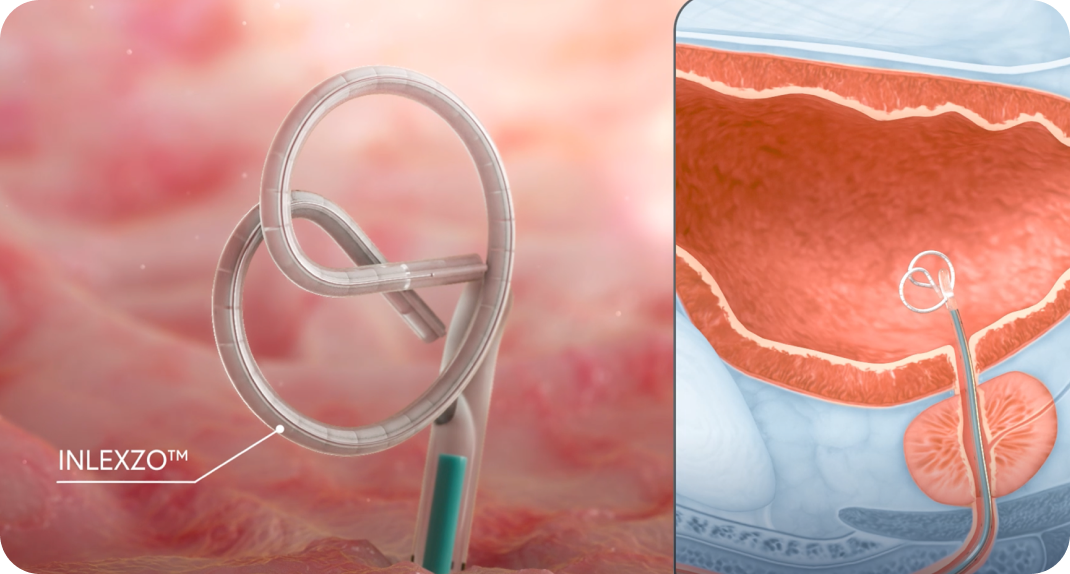
INLEXZO releases gemcitabine directly into the bladder over the course of 3 weeks1-3

Of the total gemcitabine dose, 77% was excreted by Day 7 and 99% was excreted by Day 21 in urine as gemcitabine and dFdU1

About INLEXZO
A gloved hand holding INLEXZO, with labels indicating osmotic components, gemcitabine components, and a total height under 2 inches.A gloved hand holding INLEXZO, with labels indicating osmotic components, gemcitabine components, and a total height under 2 inches.
  • INLEXZO is a sterile, non-resorbable intravesical system containing the equivalent of 225 mg gemcitabine (present as 256.3 mg of gemcitabine hydrochloride)1
  • INLEXZO contains an almost white to light pink-brown colored gemcitabine component at the center surrounded on each side by off-white to light blue–colored osmotic components1
How INLEXZO Works
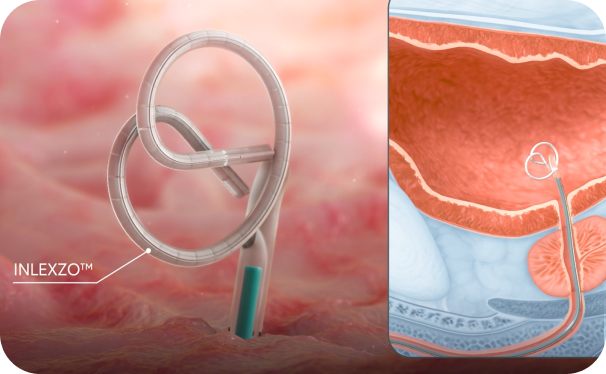
Illustration showing INLEXZO deploying from a catheter on the left, and its placement inside the bladder on the right.Illustration showing INLEXZO deploying from a catheter on the left, and its placement inside the bladder on the right.

dFdU, difluorodeoxyuridine.

†Intravesical gemcitabine is not an FDA-approved regimen in BCG-unresponsive NMIBC with CIS.7–10

Designed to provide prolonged release with less medicine vs intravesical gemcitabine1,4,5†

  • INLEXZO contains approximately one-tenth of the dose of intravesical gemcitabine (approx. 225 mg vs 2000 mg)1,5

INLEXZO is administered in a familiar, in-office procedure1

  • Inserted via transurethral catheterization and removed via cystoscopy6
  • No urine retention required after insertion and patients are free to go1
  • Instruct patients not to empty the bladder immediately prior to the insertion procedure.1 See Dosing and Administration below for administration and patient counseling

dFdU, difluorodeoxyuridine.

†Intravesical gemcitabine is not an FDA-approved regimen in BCG-unresponsive NMIBC with CIS.7–10

INLEXZO Overview Video

Discover how INLEXZO fits into the current treatment landscape, and what makes the drug releasing system unique

Dosing and Administration

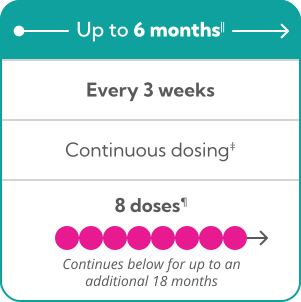
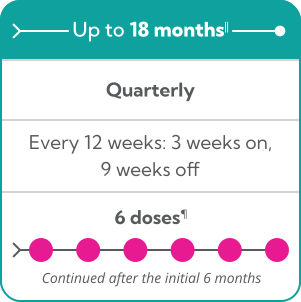
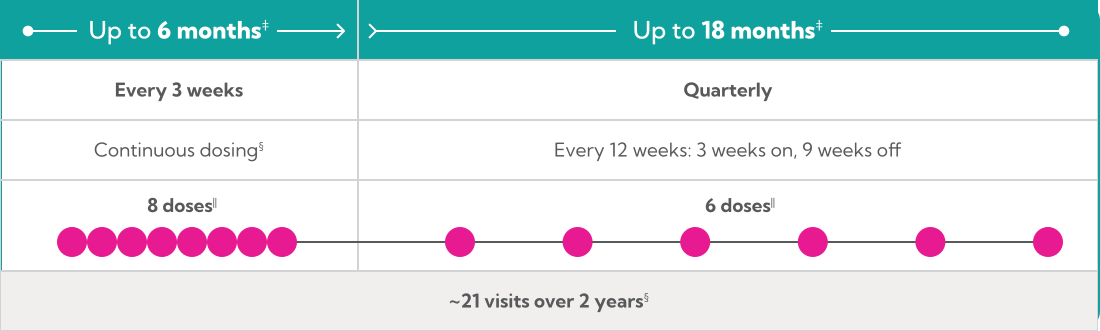
INLEXZO offers continuous dosing for the first 6 months‡ followed by quarterly dosing1§

Remove INLEXZO after each 3-week indwelling period

INLEXZO dosing schedule chart showing up to 6 months of continuous dosing every 3 weeks for 8 doses, followed by up to 18 months of quarterly dosing every 12 weeks (3 weeks on, 9 weeks off) for 6 doses, totaling approximately 21 visits over 2 years.INLEXZO dosing schedule chart showing up to 6 months of continuous dosing every 3 weeks for 8 doses, followed by up to 18 months of quarterly dosing every 12 weeks (3 weeks on, 9 weeks off) for 6 doses, totaling approximately 21 visits over 2 years.INLEXZO dosing schedule chart showing up to 6 months of continuous dosing every 3 weeks for 8 doses, followed by up to 18 months of quarterly dosing every 12 weeks (3 weeks on, 9 weeks off) for 6 doses, totaling approximately 21 visits over 2 years.INLEXZO dosing schedule chart showing up to 6 months of continuous dosing every 3 weeks for 8 doses, followed by up to 18 months of quarterly dosing every 12 weeks (3 weeks on, 9 weeks off) for 6 doses, totaling approximately 21 visits over 2 years.

‡Assumes same-day removal and new insertion during first 6 months.1

§Insertion every 12 weeks with removal 3 weeks after each insertion.1

∥Or until persistent or recurrent NMIBC, disease progression, or unacceptable toxicity.1

One dose=insertion and removal 3 weeks later.1

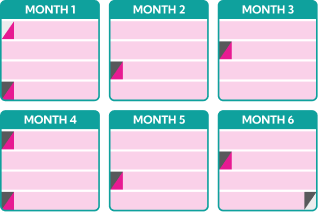
Initial Period

First 6 months

Once every3 weeks
8doses
Calendar dosing schedule chart showing up to 6 months of continuous 3-week insertion and removal cycles for INLEXZO during the Initial Period of treatment.Calendar dosing schedule chart showing up to 6 months of continuous 3-week insertion and removal cycles for INLEXZO during the Initial Period of treatment.
Insertion
Remove INLEXZO after each 3-week indwelling period

1 INLEXZO dose
(225 mg gemcitabine)

INLEXZO in bladder (3 weeks on)
Time between treatment (9 weeks off)

Removal may be done during the same visit as the next insertion during the first 6 months

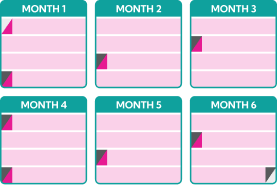
Continuation Period

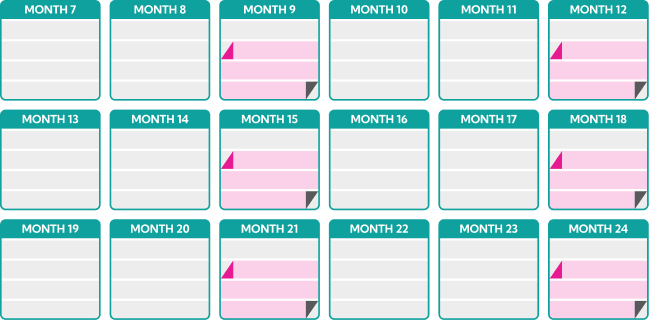
Next 18 months

Once every12 weeks
6doses
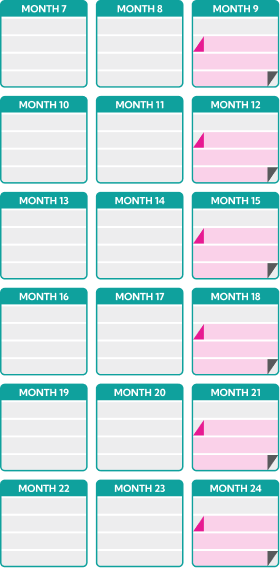
Calendar dosing schedule chart showing Months 7 to 24,  with 6 total doses administered once every 12 weeks after the first 6 months, with removal of INLEXZO 3 weeks after each insertion.Calendar dosing schedule chart showing Months 7 to 24,  with 6 total doses administered once every 12 weeks after the first 6 months, with removal of INLEXZO 3 weeks after each insertion.

Dosing is once every 12 weeks after first 6 months#

#Insertion every 12 weeks with removal 3 weeks after each insertion.

Removal6

  • Removal by flexible or rigid cystoscope and non-cutting grasping forceps

Missed Dose1

  • If a dose is missed, it should be administered as closely as possible to the original treatment schedule

Prophylactic Antibiotics1

  • Prophylactic antibiotics may be used at the discretion of the treating healthcare provider with each INLEXZO insertion and removal

Magnetic Resonance Imaging (MRI) Scans1,6

Magnetic Resonance Imaging (MRI) Scans1,6

  • INLEXZO contains a metal wire. When INLEXZO is indwelling in the bladder, the patient can only be safely scanned with MRI under certain conditions

Please read full Prescribing Information for INLEXZO for specific MRI scanning conditions.


IMPORTANT INFORMATION AND CONSIDERATIONS

Administration Considerations1

Administration Considerations1

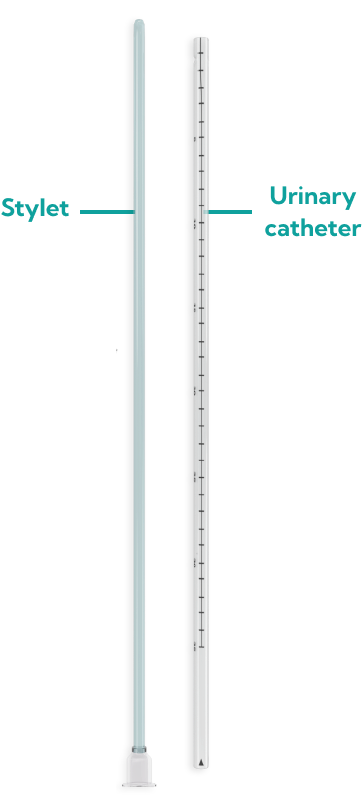
  • Administer INLEXZO intravesically only. Do NOT administer by any other route. INLEXZO is co-packaged with a urinary catheter and stylet used to insert INLEXZO through the urinary catheter into the bladder. Administer using the co-packaged urinary catheter and stylet only
  • INLEXZO should be inserted and removed by a trained healthcare provider. Healthcare providers should become thoroughly familiar with the insertion and removal instructions before attempting insertion or removal of INLEXZO

Handling Considerations1

Handling Considerations1

  • INLEXZO is a hazardous drug. Follow applicable special handling and disposal procedures while handling INLEXZO and during the insertion and removal procedure

Read full Instructions for Use for additional handling considerations.

Patient Counseling Regarding Intravesical Administration1

Patient Counseling Regarding Intravesical Administration1

  • Instruct patients to drink approximately 1500 mL/6–7 cups of fluids per day during therapy with INLEXZO to ensure adequate urine production for drug release
  • Instruct patients not to empty the bladder immediately prior to the insertion procedure. Presence of urine in the bladder can facilitate deployment of INLEXZO. Patients can resume micturition after the insertion procedure
  • Advise patients to avoid contact with urine while INLEXZO is indwelling in the bladder for approximately 3 weeks and for at least 24 hours post-removal
  • During indwelling period of approximately 3 weeks, advise patients to void urine sitting on a toilet, to wash hands with soap and water and to wash their genital area with water after each urination, and to flush the toilet after use
  • Advise patients to wash clothing soiled with urine promptly and separately from other clothing
  • Complete the MRI Safety Information Card and give it to the patient. Advise the patient to carry the card and show it to their HCP in case of need for MRI scans

Please refer to Section 17 of full Prescribing Information for complete patient counseling information.

Watch the Procedural Video for INLEXZO

This video explains the preparation, insertion, removal, and disposal of INLEXZO

For details on insertion and removal, please read full Instructions for Use.

~99% (745/755) of attempted insertions were successful (N=85 patients) in the SunRISe-1 study2

A successful insertion of INLEXZO was defined as obtaining transurethral access to the bladder using the urinary catheter with the ability to fully advance the stylet until INLEXZO was deployed in the bladder.

Disclaimer: This information is not in the Prescribing Information. It is being provided for descriptive purposes; results require cautious interpretation.

Storage and Handling

INLEXZO is the only off-the-shelf FDA-approved intravesical product for BCG-UR NMIBC CIS1,11–15**

Focus on patients, not preparation

Room temperature storage1

Store in the original carton at 20°–25°C (68°–77°F)

No thawing or special preparation prior to use1,6

INLEXZO does not require freezing, refrigeration, reconstitution, or use of a hood for preparation

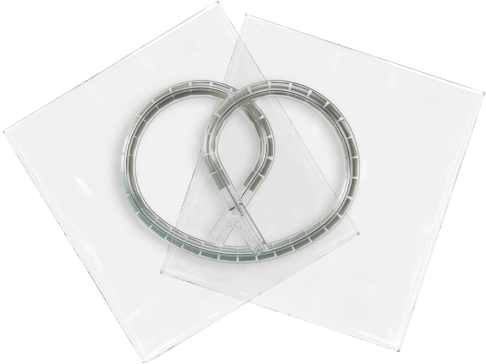
Illustrative depictions.
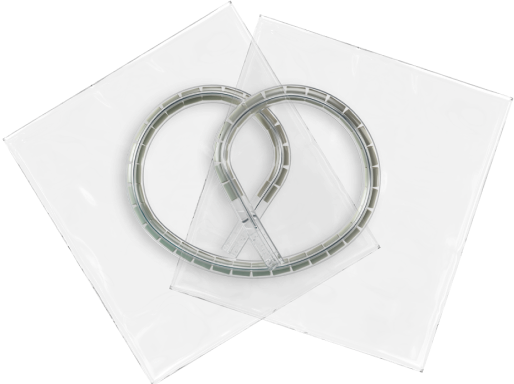
Illustrative depiction of INLEXZO shown with its clear packaging pouches.Illustrative depiction of INLEXZO shown with its clear packaging pouches.

INLEXZO

Illustrative depiction of INLEXZO package components labeling the stylet on top and the  urinary catheter on the bottom.Illustrative depiction of INLEXZO package components labeling the stylet on top and the  urinary catheter on the bottom.

Carton includes one sterile single dose of INLEXZO co-packaged with one sterile urinary catheter and one sterile stylet

INLEXZO is a hazardous drug. Follow applicable special handling and disposal procedures

Please read full Prescribing Information and Instructions for Use for complete information on how to prepare and administer INLEXZO.

BCG, Bacillus Calmette–Guérin; CIS, carcinoma in situ; NMIBC, non–muscle invasive bladder cancer; UR, unresponsive.
**As of 09/26.
References: 1. INLEXZO™ [Prescribing Information]. Horsham, PA: Janssen Biotech, Inc. 2. Data on file. Janssen Biotech, Inc. 3. Palugan L, Cerea M, Cirilli M, et al. Intravesical drug delivery approaches for improved therapy of urinary bladder diseases. Int J Pharm X. 2021;3:100100. doi:10.1016/j.ijpx.2021.100100 4. Laufer M, Ramalingam S, Schoenberg MP, et al. Intravesical gemcitabine therapy for superficial transitional cell carcinoma of the bladder: a phase I and pharmacokinetic study. J Clin Oncol. 2003;21(4):697–703. doi:10.1200/JCO.2003.09.028 5. Daneshmand S, Kamat AM, Shore ND, et al. Development of TAR-200: a novel targeted releasing system designed to provide sustained delivery of gemcitabine for patients with bladder cancer. Urol Oncol. 2025;43(5):286–296. doi:10.1016/j.urolonc.2024.12.264 6. INLEXZO™ [Instructions for Use]. Horsham, PA: Janssen Biotech, Inc. 7. Gemcitabine [Prescribing Information]. Lake Forest, IL: Hospira, Inc. 2024. 8. Gemcitabine [Prescribing Information]. Morgantown, WV: Mylan Institutional LLC. 2024. 9. Gemcitabine [Prescribing Information]. Schaumburg, IL: Sagent Pharmaceuticals. 2024. 10. Gemcitabine [Prescribing Information]. Chicago, IL: Meitheal Pharmaceuticals. 2024. 11. Anktiva® [Prescribing Information]. Culver City, CA: ImmunityBio, Inc. 2024. 12. Adstiladrin® [Prescribing Information]. Kastrup, Denmark: Ferring Pharmaceuticals. 2026. 13. Tice® BCG [Prescribing Information]. Durham, NC: Merck Teknika LLC. 2026. 14. Jelmyto® [Prescribing Information]. Princeton, NJ: UroGen Pharma, Inc. 2025. 15. Valstar® [Prescribing Information]. Malvern, PA: Endo USA. 2024.

;